Who Can Perform Your Last Rites?
(From Udaylal Pai’s WhatsApp Broadcast List) There is an incident from two months ago that has been weighing heavily on my heart.
These days, jara–old age–is slowly catching up with my eyes and, perhaps, my memory too. I have been racing against time to translate my older fiction–novels I wrote back in the 1980s–and put them on Amazon while I still can. Because of that, I spend much less time on my phone. And when hundreds of messages accumulate on my WhatsApp broadcast account, inevitably, I miss some.
Unfortunately, I missed one message I wish I had never missed.
It was from a man who had been reading me for nearly fifteen years. His question was very simple: “I have only one daughter. According to our Dharma, can she perform my last rites?”
I did not see his message in time. Two months later, while scrolling through old messages, I happened to notice it. I replied immediately.
But I was too late.
His wife answered: “Udayji, I am sorry to inform you that he had already passed away.”
Only then did the full weight of his question hit me. He had been nearing the end of his journey–a devout man, quietly anxious about what would happen after his death. Having read my writings for so many years, he trusted me enough to seek a few words of reassurance.
And I had remained silent–not intentionally, but silent nevertheless.
His wife gently explained that a distant relative had eventually performed the rites. In a practical sense, everything had been taken care of.
But that was not what troubled me. Perhaps a few words from me would have eased one small anxiety in a dying man’s mind. But those words never reached him when he needed them.
I apologized to his wife. She was gracious and told me not to feel bad–yet strangely, her kindness only made the burden heavier.
I cannot go back and answer him now. I can only learn from the silence I unknowingly gave him. That is why I have moved this WhatsApp Broadcast account from a non-voice device to a regular phone. You may call me too. I may not always be able to answer immediately. If I miss your call, I will try to call you back when I can.
I cannot answer every question in life. But if someone reaches out to me carrying something heavy in their heart, I do not want to discover those words only when it is too late.
So let me answer his question now–the answer I wish I had been able to give him while he was still alive.
Who can perform your last rites?
The short answer is surprisingly reassuring: the absence of a son does not mean that your last rites cannot be performed. Hindu tradition provides a succession of people who may perform them–and when circumstances demand it, that circle can become remarkably wide.
In that practical sense: almost anyone.
Hindu tradition does prescribe an order of preference–adhikara (eligibility)–for performing Antyeshti (funeral rites) and Shraddha (ancestral offerings). Classical texts such as the Garuda Purana, Dharma Sindhu and Nirnaya Sindhu discuss who may undertake these duties when the person ordinarily expected to perform them is unavailable.
The exact rules and procedures vary according to varna (vocation), ashrama (stage of life), sampradaya (tradition), community, family tradition and circumstances. A son traditionally occupies an important place in funeral rites. But a son is NOT the only person who can perform them.
Depending on the tradition and circumstances, that responsibility can pass through the family–to descendants, the wife, daughter, daughter’s son, brothers and other relatives.When close family members are unavailable, traditions explicitly allow a disciple or friend to step forward.
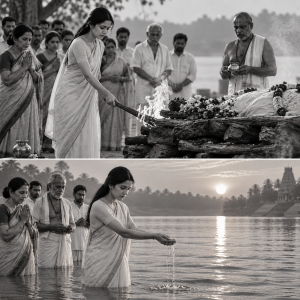
Let me state this clearly: “Yes, a daughter can perform the last rites of her parents.”
Traditional authorities such as the Dharma Sindhu and Nirnaya Sindhu recognize daughters within the succession of eligibility for ancestral rites in relevant circumstances. Ancient Dharma literature also preserves the institution of the putrikā, or appointed daughter. Manusmriti 9.127 connects the putrikā institution with continuation of the father’s funeral obligations through her line, while 9.130 declares the daughter equal to the son in its discussion of inheritance. It also asks: “How then can anyone else take the inheritance when one’s own daughter is present?”
Today, many knowledgeable Vedic scholars and priests accept daughters performing Antyeshti, and Indian judicial decisions have also recognized daughters’ roles in funeral and Shraddha rites in relevant circumstances.
So if you have only daughters, please do not spend your final years worrying that there will be nobody to perform your last rites. Dharma does not become helpless merely because there is no male child.
Perhaps that is the answer I wish I could have given that reader when he was still alive: “Do not be afraid because you have no son.”
Your daughter can stand beside you through life, and when the time comes, she need not stand helplessly aside merely because she was born a daughter. Never underestimate bhāva and sankalpa–the sincerity and intention with which an offering is made.
There is a moving reminder of this even in the Mahabharata. Krishna had sons and descendants, yet after the destruction of the Yadava clan and Krishna’s own departure, it was Arjuna–his cousin, friend and lifelong companion–who undertook the final responsibilities for Krishna and the departed Yadavas. The Mausala Parva describes Arjuna coming to Dwaraka and performing the funeral duties after the catastrophe. Dharma, evidently, did not become impossible simply because a particular son was absent.
And there is the cherished tradition of Sita at Gaya. At the Falgu, Sita is remembered as having offered pinda for her father-in-law Dasharatha. At Sita Kund, that memory remains part of the sacred landscape even today. Whatever later restrictions custom may have placed upon women, the very presence of this tradition is a powerful reminder that a woman’s offering to the ancestors is hardly alien to Hindu Dharma.should not become lesser merely because the child standing
The sacred duty we owe our parents beside them happens to be a daughter rather than a son.
Perhaps, in the end, that is what Dharma asks us to remember: not whether the hands pouring the final water belonged to a son or a daughter–but whether those hands offered it with love, sincerity and gratitude.
(To join Udaylal Pai’s WhatsApp Broadcast List, WhatsApp your name to +91-94475-33409)